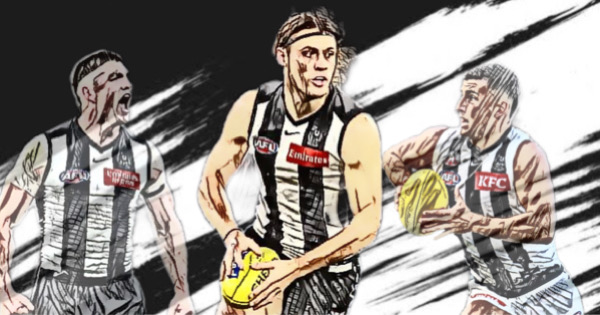

A year ago, questioning Darcy Moore’s position as captain of Collingwood would have sounded ridiculous. Now, it feels like one of the biggest conversations quietly building around the club.
And honestly, it is a fair discussion to have.
Not because Moore is a bad captain. Far from it. By all accounts, he is one of the most respected figures at Collingwood. He is intelligent, articulate, thoughtful, and admired both internally and externally. In many ways, he represents exactly what modern AFL clubs want from a captain. He handles media pressure brilliantly, carries himself professionally, and has become one of the league’s most polished public speakers.
You do not captain a club to a premiership without having genuine leadership qualities.
But footy is brutal. Especially at Collingwood.
At a club with enormous expectations and relentless scrutiny, captains are judged differently. The role is never just about leadership meetings, speeches, or media conferences. It is about performance. Presence. Durability. Emotional connection with supporters. And most importantly, the ability to stand tall when things are not going well.
That is where the conversation around Moore starts becoming uncomfortable.
Because the issue right now is not really about his leadership off the field. It is whether his on-field performances and overall influence still match what Collingwood needs from a captain moving forward.
Back in 2023, Moore looked like the perfect leader for the next generation. He was intercepting everything in defence, controlling the backline, and playing some of the best football of his career. His combination of athleticism and reading of the game made him one of the competition’s elite defenders.
At the same time, he felt like the natural successor to Scott Pendlebury. Calm. Intelligent. Progressive. Modern.
When Collingwood lifted the premiership cup, Moore looked like the ideal face of the club’s future.
But football changes quickly.
Since that premiership season, the cracks have slowly started to appear. His form has become inconsistent. Injuries have interrupted his continuity. And there have been moments where his composure under pressure has come into question.
Some of the criticism this season has been harsh, but not entirely unfair.
There have been times where Moore has looked uncertain defensively. His decision-making at crucial moments has occasionally hurt Collingwood badly. Opposition teams appear more willing to isolate him one on one, and his once dominant intercept marking has not looked quite as automatic.
For key defenders, perception can change rapidly. One bad turnover. One missed spoil. One costly mistake late in a game. Suddenly the spotlight intensifies.
And when you are captain of Collingwood, that spotlight becomes even harsher.
The criticism after the Hawthorn draw earlier this season showed exactly how quickly public opinion can shift. A late mistake suddenly became symbolic of broader concerns around his leadership and form. Then came another difficult night against Geelong where Moore again found himself under pressure after another heavy collision left him sidelined.
That matters because captains are always judged hardest when things go wrong.
The physical side of things is also becoming impossible to ignore. Moore’s body has taken a fair bit of punishment over the past few seasons. Calf problems, hamstring concerns, concussion issues, and general interruptions have made it difficult for him to maintain continuity.
For a key defender and captain, availability matters enormously.
A defensive unit relies heavily on chemistry, communication, and structure. When the leader of that unit is constantly in and out of the side, instability naturally follows. Collingwood’s backline looks different without Moore, but there are also times when the side looks uncertain when he is clearly battling physically.
That creates a difficult question for the club moving forward.
Can your captain still be your captain if his body no longer allows him to consistently lead from the front every week?
Then there is the emotional side of leadership, which might be the biggest factor of all.
Moore leads with calmness and intelligence. He is composed under pressure and rarely shows visible emotion publicly. During Collingwood’s premiership run, that style worked perfectly. The club was winning close games, trusting its system, and thriving under Craig McRae’s positive culture.
But supporters often crave something different when a team starts wobbling.
They want visible passion. They want fire. They want a captain throwing himself into contests and dragging teammates with him emotionally. Somebody snarling at opponents, lifting the crowd, and setting the tone physically.
That has never really been Moore’s style.
Fairly or unfairly, calm leadership can sometimes be interpreted as passive leadership when results start slipping. At a club like Collingwood, emotion matters. Supporters do not just want leadership. They want to feel leadership.
That is why players like Brayden Maynard connect so strongly with the fan base. Maynard plays with visible intensity and aggression. He embodies the hard edged mentality many Collingwood supporters love. Every contest feels personal to him, and fans respond to that immediately.
Then there is Nick Daicos, who increasingly feels like the inevitable future face of the club.
You can already sense the shift happening naturally. The way teammates gravitate toward him. The way supporters idolise him. The way the AFL markets him as one of the competition’s biggest stars.
Most importantly, Daicos performs every single week regardless of pressure or expectation.
That consistency is what defines great captains.
The greatest leaders in AFL history almost always led through performance first. Scott Pendlebury, Joel Selwood, Chris Judd, Trent Cotchin. Their teammates trusted them because they consistently delivered when games were on the line.
Moore is still capable of brilliant football. Nobody is denying that. At his best, he remains one of the most talented key defenders in the AFL.
But the consistency no longer feels guaranteed.
That does not mean Collingwood should immediately remove him as captain. Doing that mid-season would probably create more chaos than solutions. Moore is still deeply respected within the club and continues to represent Collingwood exceptionally well publicly.
But it does mean the club needs to start seriously thinking about the future.
Because the AFL moves fast.
One minute you are the fresh new captain lifting a premiership cup. The next you are the experienced veteran trying to hold off the next generation coming through behind you.
And Collingwood’s next generation is already arriving.
The conversation surrounding Moore is no longer reactionary or ridiculous. It is legitimate. It is part of the natural evolution every successful club eventually faces.
Can Darcy Moore still lead Collingwood into another premiership window?
Possibly.
But if the injuries continue, if the form remains inconsistent, and if Collingwood drifts further away from genuine contention, the pressure around his captaincy will only intensify.
Because eventually, the calls for Nick Daicos or Brayden Maynard to take over will become impossible to ignore.
And at Collingwood, once the noise starts, it rarely gets quieter.
You can find more from Dave on his own substack, It’s a Dave Thing.