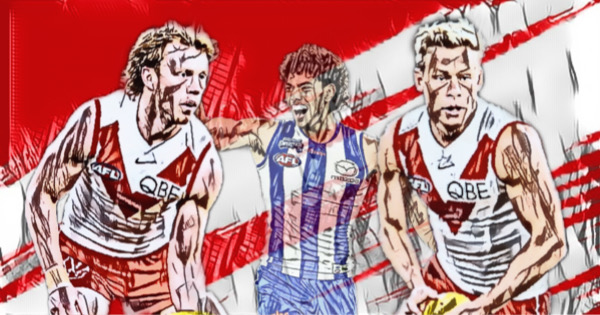

As a Swans fan and an attendee for this game, it’s hard to put exactly what happened in this contest into words. The Swans felt like they were always going to win this – I think – and it felt like they were always in danger of breaking the game open.
They obviously didn’t.
The first quarter felt like the Roos playing Marvel better than the Swans, which shouldn’t happen at a ground where you play somewhat often – dew on the ground led to slippages and truly basic skill issues. A bigger North Melbourne lead at quarter time could’ve made some noise at the full time siren. It felt like the Swans would right the ship after these initial surface issues and come good. North Melbourne made that all very difficult. More to come.
The BP Strategy
If Melbourne showed you can beat the Swans if you can run with them, North showed that if you have the defensive aptitude and willingness to commit to closing the corridor, you can gunk the Swans up (like BP did in the Gulf of Mexico) and cut off their main avenue to goal.
The difficulty in watching (and presumably game planning) for the Swans is that you know the corridor is the main avenue to goal, but so far no one’s seemed able to stop it. Defending the corridor, as they did for four quarters, takes a certain level of courage that no team has, as of yet, displayed against the Swans.
This is coming from a place of very little tactical knowhow, but to the extent that I know anything about anything it feels like chasing the game against the Swans leads to multiplicative scoring. The Swans get a lead, so the opposing team pushes forward to chase, leaving space in behind, necessitating a vacating of the corridor. This makes the team more vulnerable to being cut apart on the counter-attack.
The reason this requires courage is because it feels counterintuitive. If you need to score, common wisdom would say you need to attack more, but if attacking more leads to BEING attacked more, then should you? How much do you trust your system? How brave are you feeling against a team who, on paper, should be beating you, anyway?
The Kangaroos felt brave in this game, and, in doing so, possibly revealed the blueprint for how better (no offence intended) teams can take the game to the ladder leading Swans. That is to say, don’t take the game to them.
Gravity is Important, but, it’s a Lot of Money to Pay for Gravity
Barring the seven goal haul, it’s fair to say that Charlie Curnow’s output has been reasonably unimpressive this season when it comes to goals scored.
BUT.
It only takes this game to see that his output goes beyond the stat sheet. Joel Amartey has kicked 20 goals this season, because Sydney’s very own International Space Station produces enough artificial gravity to open up the field and allow for Joel Amartey to, ykno, get the ball and kick the goal. A thing he can do when there’s a bigger, badder dog to draw the attention of the opposition’s biggest, baddest dog – and occasionally several of said dogs.
The space Curnow creates is the additional luxury on top of the luxury of having him in the team, as inexplicable Coleman Medallist Harry McKay can attest to more than anyone else. The learnings here are that the Swans need to find a way to create goals (maybe from that midfield mix that scored more goals than any other team in the comp two years ago, just a thought) from their key forwards when they don’t have Charlie Curnow there to draw attention. Amartey tonight – six disposals, one goal, two marks. Quiet.
The Bice Problem
It’s fun to enjoy the work of Riley Bice, but Riley Bice is a luxury player. Riley Bice is the kind of guy you need in your squad when you need a second smaller version of Nick Blakey.
Nick Blakey is a freak and a ridiculous footballer, and I can understand why you would want someone else who can also run off halfback and boom kicks while also having Nick Blakey do Nick Blakey stuff wherever his brain worms decide to be at that moment. However. At a certain point, your defenders need to defend, and Riley Bice got barbecued what felt like a dozen times in this contest.
Nick Blakey can get away with being below average at defending because of his length, foot speed, and ability to make key forwards uncomfortable with his presence. Riley Bice doesn’t do that. He’s a player who makes his bones when the team’s winning, and you need to press the foot to the floor, but when you’re stuck in traffic he’s no help. Which is, unfortunately, the hardest part about driving a manual.
A Word on Defensive Ideas
The Swans defence is geared to be on the front foot and North’s is geared to not be. VFL superstar Lewis Melican and fourth gamer Williams Edwards were the Swans’ two key backs, with the rest of the back six augmented variously by any of Bice, Blakey (who’s playing his own freak role, not playing realistically as a defender), Lloyd, Wicks, Mills, Rampe, Lloyd, Cunningham.
That’s eight ball users.
The Kangaroos mix of McDonald, Logue, and Comben looked more stable, and it’s no surprise (to me) that the Swans looked more normal when Blakey played as a third tall and not as a mutant.
The Roos backline felt like it embodied the shinboner spirit that the game was calling out for, celebrating the 30-year anniversary of the premiership. The three bigs played better than the sum of their parts, demonstrating a difference in basic defensive strategy and showing that it is in fact useful to have defenders who can defend. Their organisation was incredible all game, backing up the work done in the midfield and allowing North to play the game plan that they needed to slow the Swans down.
LDU
This is just a section where I talk about how fucking good Luke Davies-Uniacke is.
Wowee. I don’t think there’s a better player in the league at staying vertical in a tackle, and his ability to yin and yang with Sheezel brings out the absolute best in both of them. Davies-Uniacke is the junkyard dog that scared Cox into chucking the vaunted tag onto him at half time, in doing so opening up the floor for Sheezel to have 12 for the quarter, and forcing Cox to move the magnets again and put Jordon back on Sheezel, once again opening up LDU. A combination of these two players would be perfect, and probably rhyme with Barcus Montempelli, but two players can cause opposing coaches nightmares.
On that note, I know the tag is having a resurgence, but when a team has two good midfielders – especially two midfielders whose skill sets are diametrically opposed like Sheezel and LDUs are – what’s the benefit of having a true tagger? Jordon didn’t neutralize either, and his impact as a footballer on his own merits is negligible.
When he tagged LDU and LDU was kicking the ball out of the defensive 50, Jordon was occasionally the Swans highest up forward. He’s not the kind of guy who should be the highest up forward. It’s not his skill set. He gets the ball and looks like the memetic polar bear in Arlington, Texas. Would the Swans not be better off trusting that the players just win on their face, rather than trying to get one guy to dull someone else’s sparkle?
I’m not sure who the player is here, or who the answer is, but Jordon – kinda like Bice, in a way – feels like a player who should be horses for courses rather than an automatic selection. The tag, in a magnificent reflection of the bell curve having shown why it returned in the first place, is threatening to remind us why it fell away.
Also, final thought, the role swap to put Zurhaar back and McKercher in a floating HF/Mid role is working. Zurhaar is having whatever impact but McKercher is really good in his new role, and his speed, combined with the willingness to take the game on, has the capacity to blow games open.