
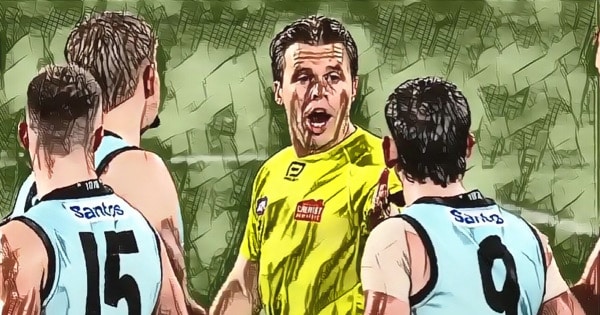

It looks like the aspect of Gather Round that gets the most press won’t be the record attendance, Essendon breaking their losing streak, the contest between SANFL and VFL representative sides that went down to the wire, or even anything Nick Daicos did. It certainly won’t be Zak Butters’ brilliant performance – rewarded with nine coaches’ votes – in a disappointing loss for the Power. No, it will be Zak Butters being reported by umpire Nick Foot for alleged abuse and the resulting fine imposed by the tribunal.
A dispute between a player and an umpire was always going to be controversial. And the outcome isn’t exactly surprising – though it does deserve attention since it was, I’ll argue, the wrong decision, with broader implications for fans’ trust, or lack thereof, in the AFL.
We know the league is concerned about actions at the top level filtering down to local and junior footy. Since news of the Butters-Foot incident broke, Andrew Dillon and the tribunal members have likely been plagued with visions of innumerable junior footballers blatantly accusing umpires of match-fixing and then protesting, all wide-eyed innocence, “All I said was, how’s that a free kick?”
Yes, players at all levels should respect umpires, without whom it would be quite a bit harder to play footy. Back in the very earliest days of the game, the team captains would decide when free kicks were to be handed out – and as amusing as it is to imagine James Sicily and Zak Butters being in charge of paying free kicks when Hawthorn and Port Adelaide meet this weekend, such an arrangement would distract them from the game and open up all manner of new sources of controversy. So we definitely need umpires.
But if the goal is for players and fans to respect umpires, the tribunal’s decision is counterproductive. That’s because it’s also poor on the merits: the evidence favours Butters here, and finding him guilty gives the impression that the AFL and the tribunal care more about appearances than truth. Let’s take a closer look at the situation.
The AFL’s lawyer made much of the inconsistency between Butters’ statement immediately after the game and his statement at the tribunal. When interviewed postgame by Channel 7 reporter Xander McGuire, Butters stated that he’d said, “How’s that a free kick?” At the tribunal, in contrast, he testified that he’d said, “Surely that’s not a free kick.”
I mention that point, and will respond to it, because it was part of the AFL’s legal argument. The tribunal, though, focused on a different inconsistency, which was key to the verdict: Wines and Foot both remembered Butters making multiple comments about the free kick, whereas Butters remembered only one. Case closed, right?
Not so fast.
Human memory is in fact unreliable. We can be absolutely certain of memories that are actually false. Moreover, Butters’ memory is consistent here when you look at the actual meanings of the phrases he’s remembering. “How’s that a free kick?” and “Surely that’s not a free kick”, taken in context, both express incredulity at the umpire paying the free kick in question. For that matter, so does “How can you pay that?” which is the question some have speculated he asked. It’s not surprising that Butters, after playing a game of footy, wouldn’t perfectly remember either the exact words he used or how many phrases he spoke in the heat of the moment. The important thing is that he was simply objecting to the free kick, not suggesting the umpire was on the take. In that regard also, his testimony agrees with that of Wines.
But wait, some of you may be saying. If memory is so unreliable, how can we be sure that Butters was correctly remembering the basic meaning of his words? How can we know that he isn’t honestly misremembering when he says he was just protesting the free kick, not challenging Foot’s integrity?
First, that question cuts both ways. If we’re going to go that far in doubting Butters’ memory, we should also doubt Foot’s memory of what he heard. Both were operating in a loud, high-pressure environment with many distractions, and both seem to have been emotionally invested in doing their jobs. So that level of scepticism takes out both sides of the case.
Second, we can look at Butters’ and Wines’ reactions in the moment to see if they’re more consistent with Butters objecting to a free kick or with Butters implying Foot was paid to fix the game. And their reactions indicate bewilderment at Foot’s response to Butters’ comment. Butters is clearly puzzled when Foot pays the 50-metre penalty. He points to himself and looks around, as if he’s not even sure he’s the one who gave away 50. If he’d implied Foot was corrupt, he’d hardly have wondered why, or whether, the umpire was displeased with him. Butters doesn’t look angry or out of control; he looks genuinely confused. And when Foot says, “I’m reporting you”, Butters still looks confused and seems to have no idea what he’s done wrong.
The video shows that Wines, too, looks truly confused by the report. The available audio reveals that after Foot tells Butters, “I’m reporting you”, Wines says, “For what?” in a baffled tone. For Wines to be so surprised that an umpire was reporting Butters, he must have been confident that Butters had done nothing wrong.
It’s also unsurprising that Wines’ recollection of how much Butters said would differ slightly from Butters’ memories. Again, memory is unreliable, and it’s easier to remember that Butters didn’t say anything offensive, as well as the general sense of what he did say, than it is to remember the precise words he used or exactly how many sentences he spoke. You probably don’t remember everything you said yesterday, or even in the last few hours. But you do remember that you didn’t accuse anyone of taking bribes – at least, I hope you didn’t. Similarly, Butters and Wines don’t perfectly remember the words Butters used to question the free kick, but they do remember that he was questioning the free kick in a normal way and that he wasn’t suggesting anyone had paid Foot to fix the game. And their reactions at the time are fully consistent with the statements they’ve made.
The testimony of Ben Rutten, Port Adelaide’s GM of football, at the tribunal provides additional confirmation that Butters, right after the incident, did not know why he had been reported. According to Rutten, Butters came off the field immediately after being reported and then, speaking to Rutten on the bench, showed distress and confusion over the 50-metre penalty and the report. Such confusion would be implausible if he’d asked the question he was accused of asking.
The tribunal suggests that Butters’ confusion is simply “consistent with him believing the offending comment did not warrant a 50-metre penalty in the circumstances”. But Butters’ anger at the accusation against him makes it clear that he understands how offensive it would be to ask an umpire, “How much are they paying you?” His onfield reaction indicates more than mere surprise that an umpire was quicker to pay 50 than he expected; it indicates absolute bewilderment than anyone could have taken offence to what he said. And his continued defence of himself shows that there’s much more at stake for him than a 5-metre penalty and a fine. He’s defending his integrity because he knows that he never asked the question he’s been accused of asking.
In fact, Butters doesn’t really seem to mind being fined in and of itself. He is, famously, the most fined player in AFL history. He’s so used to it that in his 2024 John Cahill Medal acceptance speech, he thanked his accountant for helping him pay his fines! Based on precedent, he’d have expected that being reported for umpire abuse would lead to a fine. Certainly he was unhappy about the 50-metre penalty, but why would he keep defending himself so vigorously just to get out of paying another fine? He wouldn’t be so angry if he didn’t know that he never said anything offensive.
And, as a number of people, including Port’s legal counsel, have pointed out, Butters had no way of knowing, at the time of his postgame interview, that the umpire’s microphone hadn’t picked up his remark. Nor did Wines know that the microphone hadn’t caught Butters’ words when he promised to testify in support of his teammate and acting captain. Expecting there to be a recording, they wouldn’t have risked a lie.
Human hearing is also imperfect, particularly in noisy environments. Proposing that Foot misheard is questioning his ability to hear perfectly in a loud stadium, not his integrity. Last time I checked – 7:19 pm on Tuesday via a Google search – “hearing” and “integrity” have very different definitions. Port Adelaide’s lawyer was careful to suggest only that Foot misheard, never that he was lying. Foot is the one who decided to dig his heels in and insist that his integrity was at stake.
The tribunal finds it “implausible that Mr. Foot misheard the words ‘Surely that’s not a free kick’ as ‘How much are they paying you?’” But the tribunal also finds that “it is not surprising that Mr. Wines did not hear the offending comment” because “Mr. Foot’s unchallenged evidence was that Mr. Butters made the offending comment at a lower volume than his earlier comments”, while “Mr. Wines was at least 1.5 metres away from Mr. Butters”. But if Butters was speaking so quietly as to be inaudible to Wines over a relatively short distance, how can the tribunal be so certain that Foot did not mishear? Yes, he was a bit closer to Butters, but in a loud stadium, it would be easy to mishear a comment made quietly. The claim that Butters was speaking quietly actually works in his favour, since the more quietly he was speaking, the less certain it becomes that Foot heard correctly.
It’s Butters whose integrity is really being questioned here. The official tribunal decision is careful not to claim he lied, but that would be an unsurprising conclusion to come to if one accepts the tribunal’s reasoning. Given the weakness of the case against Butters, and the seriousness of the charge against him, it is good to see that Port Adelaide is continuing to stand up for Butters’ good character and the AFLPA has also expressed support for him. It is unacceptable for a player’s reputation to be tarnished in this way when the available evidence actually supports his case.
Insisting that an umpire could not possibly have misheard a comment addressed to him from behind in a packed Adelaide Oval will not increase respect for umpires. If anything, it’s already doing the opposite. The perception that umpires are a protected species just makes people angrier at every dubious or potentially questionable decision.
I’ve mentioned the AFL’s concerns about respect for umpires in junior and local leagues. But junior and local footballers won’t magically become more respectful if they think umpires are oversensitive and incapable of admitting they might have genuinely misheard something. Here, the evidence indicates that Butters is telling the truth and Foot did mishear. If a dispute does arise that can’t be settled one way or the other, the mature thing to do is to leave it on the field and accept that not all problems can be solved. It’s simply not possible to prevent every conceivable bad thing by punishing scapegoats. Besides, when it becomes too obvious that you’re punishing someone for a thing he didn’t do, people justifiably get angry, because fining a player without evidence is also bad.
Although the AFL is supremely concerned with optics, a quick look at social media will tell you that the optics of this decision are atrocious. Full disclosure, I am a Port Adelaide supporter, Zak Butters is my favourite player, and I desperately hope he signs a long-term contract extension with Port. But the outpouring of support for him on the AFL subreddit, of all places, shows that this is bigger than one club or one player. This is about integrity – the integrity of the AFL and the tribunal, which fans are rightly questioning.
If the decision were right, the optics of it shouldn’t matter. “Let justice be done, though the heavens fall”, as the ancient Roman adage may or may not have said (the maxim’s antiquity is disputed). I’ve argued, though, that the decision is wrong, which means the AFL and the tribunal have failed on two counts here. First, Butters has been found guilty when he should have been found not guilty. Second, precisely because it’s so clearly unjustified, the decision has tarnished the image of the game. The league’s worries about optics have led to a result that is actually terrible optics.
Moreover, the AFL has an odd blind spot when it comes to the optics of associating with the gambling industry. Butters, Wines, Rutten, and Port Adelaide’s legal counsel didn’t question Foot’s integrity. But plenty of footy fans are doing just that. To be clear, I am not suggesting that Foot’s employment at SportsBet has affected his umpiring in any way, and I am not questioning his integrity. I am observing that it is very bad optics indeed for an umpire to work at SportsBet, even though he’s employed as a horse racing analyst and does not work for the football division.
Concern for optics isn’t always misplaced: it is important to avoid even the appearance of conflicts of interest. By signing off on Foot’s SportsBet position while he continues to work as an AFL umpire, the AFL has permitted a perceived conflict of interest that exposes Foot to greater scrutiny from supporters. This perception of a conflict of interest decreases respect for Foot specifically and for the AFL and their umpires in general.
Perhaps the AFL doesn’t see anything wrong with an umpire working as a SportsBet horse racing analyst because the AFL itself has close, and very public, ties to the gambling industry. I’m not suggesting that these links between the AFL and gambling have anything to do with the Butters tribunal decision. That decision, I suspect, was driven by the desire to appear supportive of umpires. The point is that it’s ironic for the AFL to worry so much about optics while profiting from its association with an industry that benefits from particular outcomes in games. I am not alleging that this association ever has affected any outcomes. Rather, I’m saying that, especially given how destructive gambling can be to people’s lives, it’s unwise and unvirtuous – not to mention bad optics – for the AFL to be so tightly bound to the gambling industry.
There’s something absurd in the AFL talking so much about integrity while profiting from people gambling on the footy. Moreover, the AFL has no moral right to speak of integrity while asking that a player be found guilty of umpire abuse even though the available evidence points to that player’s innocence.
Right now, fans don’t trust that the league has the game’s best interests in mind. And they’re right not to, as long as integrity takes a back seat to optics, and optics in turn take a back seat to gambling dollars.