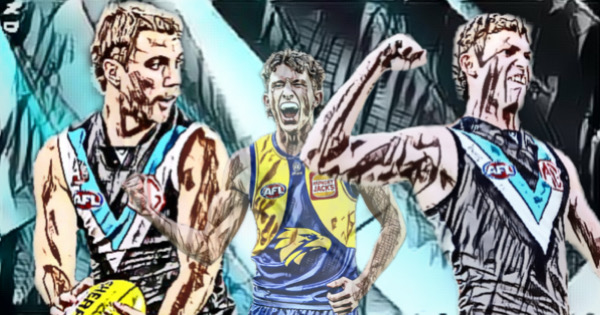

I’ve watched a fair bit of West Coast this year and I’m starting to like what I’m seeing.
A few months ago, I wrote in a review of their game that I wasn’t sure what Andrew McQualter was trying to make this team do. They seemed without plan or purpose. But, over the last month, I’ll admit that I may have been a little quick to judge. The Eagles have started to find something – they were unlucky not to ruin Pendlebury’s big day, they’ve beaten GWS, and they looked more than competent against the lacklustre Bombers – and, most importantly, snuck a win over Port at their home ground earlier in the year.
I was also interested in seeing whether Port had any fight. This team that can beat Geelong and match it with other quality sides like Hawthorn, Adelaide, the Dogs but can lose to fellow bottom sides like West Coast and North Melbourne, leave me wondering what to expect. Do they have the courage to come to Perth can stamp all over the Eagles – to bring their best, the type of footy they’ve shown against top sides, and treat it like a grudge match? Can they be angry? Port aren’t a terrible side – they should be in a better position than the Eagles – but as we head into this game, they’re not. No, the Power were ripe for the taking here, and the Eagles would have wanted to take this scalp to send a message to their fans and the broader community that their progress is going upwards and their system is starting to work.
It might not be a game of great importance in the context of the season, but for both these sides, it was an opportunity to show who they are and who they can be. It proved to be an intriguing game, messy, scrappy and exciting game.
In the end, Port held on for the points, but I think the Eagles walked away with pride. Here are my thoughts:
Who would be the more organised team?
I use ‘organisation’ and ‘composure’ somewhat interchangeably here, because the two go hand-in-hand. An organised defence allows a team to move quickly without panicking, and a good structure in front of the ball allows for more confident and composed ball movement going forward.
Port’s defence got themselves very organised, very early.
Esava Ratugolea was everywhere for about three quarters, taking intercept after intercept. Aliir Aliir provided good support alongside. But, with ball in hand, their backline was shaky. Too often did Port rely on hack kicks out of their backline, which allowed the Eagles to set up, and when they had the ball going forward, their movements early were slow – as if they didn’t really have a plan and were just waiting to find an option. However, when they got the ball into their forward 50 in that first quarter, they were able to score efficiently, playing a territory game and preventing the Eagles from getting an easy exit.
Port established a decent, and in the end a telling lead, but it wasn’t convincing by any stretch. Yes, they had nine scoring shots to West Coast’s three for the first quarter – and they could have broken the game right open. But it takes more than that to convince me. Besides…
Bad Kicking is Bad Footy
West Coast were reasonably well structured early and I think they actually had a better system to move the ball, but their skills by foot were dreadful and many of their turnovers were unforced errors. Meanwhile, Port’s wasn’t much better, especially going inside 50. I’ve already mentioned the intercept marking by Ratugolea (12 intercepts for the game) and Aliir Aliir (9), but Ginbey (10) and Tyler Young (10) were gathering a pretty good supply themselves. Port continually mnanaged to find the waiting hands of West Coast defenders who would then put it lace out to a Port Adelaide midfielder, who would then kick it to another West Coast defender – and then the opposite would happen at the other end. Some of that second quarter was bordering on amateur hour.
Neither team was particularly accurate in front of goal, but I had my eye on Waterman, whose yips in front of goal have been well documented this year. He gets the award for the angriest man to take a mark and kick a goal. Frustrated at dropping a simple chance, he seemed to take it out on himself by swearing and slamming the ball on the ground as he remedied the situation with a big grab moments later – but I digress. He seemed to put his kicking woes behind him, if not convincingly. He missed one he could have kicked and one of his goals was a genuine floater, but 3.1 was a good return; However, when the game was there to be won – and Waterman was the man trying hardest to win it – that 3.1 became 3.2.
That’s the time to get angry at yourself.
What would change at half time?
As Ratugolea took about his sixth intercept mark of the half, I was struck by a memory of when Port came over to face McGovern and Barrass in their prime – back when the Eagles were really good. In that game, they nullified both those defenders by simply kicking the ball along the ground and allowing their smalls to do the scoring – and it worked. Port walked away with an upset win.
I also considered that this season, the better teams are relying a lot more on running and handball than they are on kicking and maintaining possession. Both these teams were generally going by foot and playing more of a possession game. Who was going to be brave and start taking risks?
Port maintained more of the status quo after half time. Fair enough, I suppose – they were winning and decided to trust their method. Butters was busy and trying to urge his team on with 27 touches (9 kicks, 18 handballs), but the rest of his team didn’t carry the same tenacity. They were holding on like a boxer, happy to take jabs and wear out the opposition, forgetting that they’re no Ali when it comes to endurance and counter punching.
West Coast, through Reid who was joined by Davis and Duursma led the Eagles charge, running through the middle, using handball, and being much smarter about their delivery inside 50, effectively taking Aliir and Ratugolea out of the game. They were more willing to scrap the ball forward when they needed to, causing chaos balls and trying harder to bring the ball to ground. More importantly, when they did kick it, their skills suddenly improved – at least until it came to scoring.
In the final quarter, Port were hanging on, swaying in their corner, not able to counter the continued attack by the Eagles who just needed to land one last blow to knock them out. In the end, Port managed one last goal through Horne-Francis getting out the back, and that proved enough.
Is Ginbey in the conversation for All Australian?
One of my favourite players this season is Reuben Ginbey. He’s a tough, honest player with a kick that’s almost as beautiful as his hair. He’s probably not getting the credit he deserves – although he is starting to get a bit more focus, but he is a genuine emerging star of the game and will likely be West Coast’s captain at some stage in the future.
The Eagles need about six of him – he defends well and he is able to stamp some authority on a game, as he did with a dynamite kick inside 50 to Waterman after watching about 15 turnovers happen around him. I don’t think he is quite in the form to get an All-Australian jacket, but I certainly think his name should be in the conversation – but not anymore. An extended stint on the sidelines looks likely, as he limped off the field with what looked like a fairly significant quad injury.
We have to commend the chase – he put everything into it. And we also have to acknowledge that Mitch Georgiades, when he gets into open space, has a fair bit of speed about him, as well, but seeing Ginbey blow a tyre was a little heartbreaking for the wider footy public, as I believe m,any want to see this bloke succeed.
When he went down, I thought that’d be game-over for the Eagles. And certainly, their backline started to look a lot less organised than it had to that point. Suddenly Hone-Francis and Jordon Sweet were finding space and there was a sense of discontent, a lack of leadership among the West Coast back six. But, to their credit, they managed to adjust well.
Keeping the ball out of their backline for extended periods obviously helped, but Young and McCarthy both lifted, and the entire back six started defending much more effectively than they had earlier in the game. Elliot Yeo, also had a big say, as he started to drop back as a spare defender, as well.
How good is Williams? How good is Sweet?
I was intrigued by this ruck match up, because these are two somewhat emerging ruckman (if you can still be considered emerging at 26 and 28). Williams has been having a good run and Sweet has been somewhat effective without really standing out. The result was probably Sweet’s best performance of the year. He ran Williams ragged around the ground, pushed forward to kick a goal and narrowly miss a second, while finishing with a season-high 38 hit-outs along with seven clearances. Williams was beaten but did rise towards the end with the rest of his team, and his effort in the contest can’t be faulted. Sweet may have exposed a weakness in Williams who wasn’t as able to run back defensively.
Who from Port wants to take responsibility?
As the game reached its climactic end, I was waiting for someone in Teal to stand up and take a bit of responsibility, show a bit of leadership. Butters tried, but he’d been playing well all game anyway. They needed someone else. Horne-Francis kicked what would be the sealing goal, but ultimately, it was on the back of a hack kick, lucky bounce, and a bit of run – not to diminish it, and he was good enough to make sure of it, but that’s not the bit I was looking for.
I wanted someone to join Butters in the coalface, to get in and under, get their hands on the ball but not just give it away as quickly as possible. Darcy Byrne-Jones, for instance, seemed scared of possession at times and he only had four of his 24 touches in that last quarter. Jase Burgoyne was getting around but three of his seven disposals in that final quarter were turned over, and Aliir Aliir was not only kept to the one disposal, he got so frustrated he got inexplicitly angry at an umpire because he didn’t get to a contest he should probably have tried to get to. Horne Francis may have kicked what was the winning goal, but that was his only kick – he spent the whole quarter hidden in the forward line waiting for someone else to do the hard work. No one in that quarter really stood up and tried to compose their team, to either settle things down, or to take the game by the scruff of the neck.
Port have lost quite a few close games this year, I’m not really surprised anymore. They managed to win this one, but they didn’t win it so much as the Eagles failed to win one they should have. West Coast had Waterman, Reid and co. taking the game on and making things happen and will look back at this effort with positivity, only regretting those missed opportunities. Port, however, will take the four points – but are those points more important than the knowledge that they only have one player who has the guts to say, “I’m going to get my team over the line here?”
Final Thoughts:
– Willem Duursma has a bit of Inspector Gadget about him. Those long, lanky arms seem to grow a foot whenever he’s just out of reach of the ball. Give him a bit more time in the gym and, well, he’ll have strength to match his incredible class.
– Tom Cole kicked two goals and battled hard. He’s never kicked multiple goals in a game and his last quarter shot from 50 was delightful.
– Ollie Wines put in a reasonable performance with 18 touches but he could have imposed himself more
– Joe Berry was good in the first half – one disposal after half time. A disappearing act to rival The Wizard’s.
– Jobe Shanahan is fun to watch. Worked up the ground to get himself into the game, then tried to impose himself more as the Eagles got momentum.
– Bo Allan took a nice contested mark up forward. Could he be moulded into a genuine utility player?
– Malakai Champion had a quiet one, but he’s still got the best name in the game at the moment.
Well, that’s about it for me. Enjoyed the article? Consider shouting me a coffee. It helps fund important football journalism activities such as rewatching centre bounces, arguing with strangers about the Brownlow, and making questionable tips every Thursday night.”