
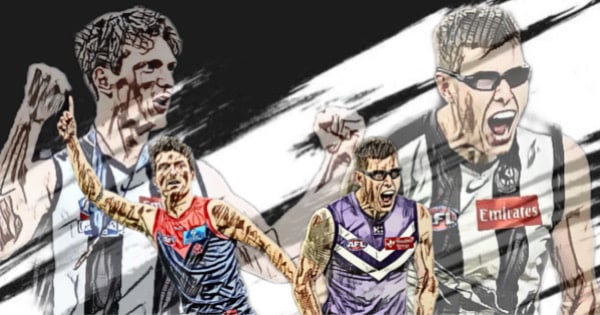

Collingwood’s Round One defeat at the hands of Adelaide has already triggered significant discussion about the structure of the Magpies’ forward line. While it is only the opening week of the AFL season-proper, the performance raised a question that many within the Collingwood fan base had quietly wondered throughout the off season. Did the club make a major list management mistake by allowing both Brody Mihocek and Mason Cox to depart?
It is a harsh question so early in the year, but football rarely waits for comfortable timelines. The Magpies’ loss exposed issues inside forward 50 that were difficult to ignore. The ball movement often looked promising through the middle of the ground, yet once the ball entered the attacking arc, the structure appeared disjointed and uncertain.
For several seasons, Collingwood’s forward setup had a clear identity. It was not necessarily the most explosive forward line in the competition, but it was functional and reliable. Mihocek served as the primary leading target while Cox provided a tall aerial presence capable of bringing the ball to ground or creating contests. Between them, they offered balance, which allowed the Magpies’ smaller forwards to thrive.
Against Adelaide, that balance appeared to be missing.
Too often, the Magpies moved the ball forward without a clear focal point. Entries inside 50 lacked direction and Adelaide’s defenders were able to intercept or spoil with relative ease. There were moments where the Collingwood midfield looked hesitant, seemingly unsure of where the ball should be delivered.
That uncertainty highlights the value that players like Mihocek once brought to the team.
Mihocek’s importance to Collingwood during his time at the club cannot be understated. While he was rarely described as a superstar, he was one of the most dependable key forwards in the competition. Season after season he provided consistent goal scoring while also acting as a strong link between midfield and attack. He is a five-time Gordon Coventry Medallist at the club. they don’t just hand them out to anyone.
His ability to lead hard at the ball carrier and present a reliable marking option made life significantly easier for Collingwood’s midfielders. When the Magpies needed a target inside 50, Mihocek was almost always there.
His absence was noticeable in Round One.
Adding to the scrutiny surrounding Collingwood’s decision is the fact that Mihocek made an immediate impact at his new club. After exploring his options through free agency at the end of the 2025 season, Mihocek ultimately signed with Melbourne. The move allowed him to continue his career elsewhere without a trade being required, and Melbourne wasted no time integrating him into their forward structure.
In his first game for the Demons this weekend, Mihocek kicked three goals in his debut. It was the type of performance Collingwood supporters had grown accustomed to seeing over the years.
Mihocek worked tirelessly to create opportunities, presented strongly at the ball and finished his chances when they came. It was not a spectacular display filled with highlight reel moments, but it was effective and efficient.
For Collingwood fans watching their former forward slot three goals for Melbourne while their own attack struggled to find rhythm, the contrast was difficult to ignore.
Then there is the departure of Mason Cox.
Few players in AFL history have had a career as unique as Cox. The American born tall forward arrived at Collingwood as a raw project and gradually developed into a cult figure within the club. Standing at over two metres tall, Cox offered something few other players in the competition could replicate.
His greatest value was not always measured by goals.
Cox’s presence alone forced opposition defences to adjust their structures. When the ball was kicked high inside 50, he created aerial contests that often drew two or three opposition players to contest. That allowed Collingwood’s smaller forwards to apply pressure and generate scoring opportunities.
He also provided flexibility by supporting the ruck when required, giving the Magpies an additional tactical option.
Without Cox, that aerial presence inside 50 appeared diminished against Adelaide. The Magpies struggled to create genuine marking contests, which allowed the Crows’ defence to control the air and quickly transition the ball out of their defensive zone.
When a team cannot create pressure inside its forward line, it often places additional strain on the midfield and defensive units.
That was evident throughout the match.
Collingwood’s midfield worked hard to generate forward entries, but without a reliable contest ahead of the ball those efforts frequently went unrewarded. Adelaide defenders were able to intercept and rebound with relative comfort.
Of course, the decision to move on from Mihocek and Cox was not made lightly. AFL list management requires clubs to constantly balance immediate competitiveness with long term sustainability. Both players were entering the latter stages of their careers, and Collingwood’s list management team clearly believed it was the right time to transition their forward structure.
From a strategic standpoint, that reasoning is understandable.
Every club eventually faces the challenge of replacing experienced players with younger talent. However, the timing of that transition can be critical. If the next generation is not yet ready to assume those responsibilities, the team can find itself temporarily weakened.
Collingwood may now be navigating that transitional period.
The responsibility now falls heavily on players such as Daniel McStay to lead the forward line. McStay was recruited with the expectation that he would become a central figure in Collingwood’s attack. While he has shown glimpses of his capabilities, consistency remains the key question.
Against Adelaide, McStay struggled to impose himself on the contest.
A key forward does not always need to dominate the scoreboard to influence a match, but they must consistently compete and provide a target for teammates. In Round One, Collingwood’s forward line lacked that presence.
When a team does not have a clear focal point in attack, the entire offensive structure can become unpredictable. Players hesitate on their leads, delivery inside 50 becomes rushed, and scoring opportunities become harder to generate.
Adelaide capitalised on that uncertainty.
The Crows’ defensive unit appeared well-organised and disciplined, frequently intercepting Collingwood’s forward entries before they could develop into genuine scoring chances. That allowed Adelaide to control territory and dictate the tempo of the game.
It is important to remember that one game does not define a season. Teams often require time to develop cohesion, particularly when new combinations are being introduced. Collingwood still possesses significant talent across the field and coach Craig McRae has previously demonstrated his ability to build a cohesive and competitive side.
However, the issues exposed in Round One cannot simply be dismissed as early season rust.
Forward line chemistry is built through familiarity and repetition. Players must understand each other’s movements and anticipate where the ball will be delivered. Mihocek and Cox had spent years developing those connections with their teammates.
Replacing that level of understanding is rarely immediate.
Collingwood’s challenge now is to establish a new forward structure capable of producing consistent results. Whether that comes through McStay, emerging players or tactical adjustments remains to be seen.
What is clear is that the decision to part ways with Mihocek and Cox will continue to attract attention if the Magpies struggle to convert their opportunities.
Seeing Mihocek immediately deliver three goals in his Melbourne debut after leaving via free agency only intensifies that scrutiny.
Collingwood’s list management team believed they were making a necessary decision for the future of the club. Time will ultimately determine whether that call proves to be correct.
But after one round of the 2026 season, the question is already being asked.
Did Collingwood move on from two key forwards too soon?
You can find more from Dave on his own substack, It’s a Dave Thing.