

It is only Opening Round of the AFL season and, ordinarily, it would be premature to draw any conclusions from a single match. The early stages of a season are typically a period of adjustment. New players are integrating into their sides, combinations are still developing, and coaches are refining the systems they believe will carry their teams through the long year ahead.
However, there are occasions when an early season performance prompts broader reflection about a club’s trajectory. St Kilda’s 12-point loss to Collingwood on Sunday night may prove to be one of those moments.
The Saints were defeated 11.12 (78) to 9.12 (66) in a contest where they were competitive for much of the evening. They generated periods of momentum, produced a number of forward entries and showed flashes of the talent that exists within their list.
Yet despite those positives, the result also reinforced several familiar concerns and reignited an ongoing discussion surrounding the club.
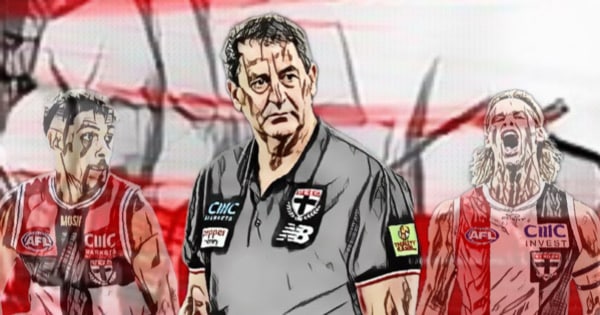
Is Ross Lyon the right coach to guide St Kilda toward genuine contention?
The Saints entered the 2026 season with renewed optimism. The club had been active during the off season, adding several notable recruits in an effort to strengthen its list, and build a side capable of competing with the league’s strongest teams.
Among the most significant additions was Tom De Koning. The former Carlton ruckman brings athleticism, versatility and additional presence around stoppages. His ability to rotate between the ruck and forward line offers structural flexibility, particularly when paired with Rowan Marshall, who has already established himself as one of the premier ruckmen in the AFL.
The Saints also secured the services of Jack Silvagni, whose versatility allows him to contribute in multiple roles. Silvagni’s strong work rate, aerial ability, and football awareness provide St Kilda with a valuable option capable of supporting the defensive unit or adding structure to the forward line when required.
Another important recruitment was Sam Flanders. After developing into a highly productive midfielder during his time on the Gold Coast, Flanders brings additional creativity and attacking drive to the Saints’ midfield rotation. His capacity to win the ball and move it forward with intent was viewed as a key addition to a team seeking greater offensive impact.
These acquisitions, combined with the Saints’ existing core players, suggest a list that should be capable of taking meaningful steps forward.
St Kilda’s leadership structure also reflects a group that is beginning to transition into a new era. The club is led by co captains Callum Wilkie and Jack Sinclair, two players who have earned enormous respect within the playing group through their consistency and professionalism.
They are supported by a six-man leadership group that includes Mason Wood, alongside first-time leaders Nasiah Wanganeen-Milera, Marcus Windhager and Mitch Owens. The inclusion of these younger players signals the club’s intention to develop its next generation of leaders while maintaining experienced guidance within the squad.
Within that leadership group sits a blend of experience and emerging talent.
Jack Macrae continues to be a central, if underrated, figure within the midfield, known for his contested work and relentless competitiveness. Rowan Marshall remains one of the competition’s most influential ruckmen, while players such as Wanganeen-Milera and Sinclair provide elite ball use and composure in defence.
In attack, Max King remains one of the most promising young key forwards in the AFL. However, King’s absence against Collingwood due to injury was significant. Without their primary key target inside the forward fifty, the Saints lacked a consistent focal point in attack. His absence placed additional pressure on the rest of the forward group to generate scoring opportunities against a well-organised Collingwood defence.
Even allowing for that absence, the match highlighted a recurring challenge for St Kilda.
Despite generating forward entries and competing strongly in key areas of the ground, the Saints struggled to convert those opportunities into meaningful scoreboard pressure.
This difficulty turning territorial advantage into goals has been a theme that has surfaced repeatedly in recent seasons.
Against Collingwood, St Kilda often moved the ball through controlled possession chains that slowed the tempo of the game. While this method can reduce the risk of turnovers, it can also allow opposition defences time to organise. On several occasions, the Saints’ forward entries arrived after Collingwood had already established its defensive structure, with the deep pockets and flanks the only avenues for the Saints to get into scoring positions.
When that occurs, even the most talented forwards can struggle to create scoring opportunities.
Collingwood, by contrast, demonstrated the value of efficiency. When their chances presented, they capitalised through composed ball movement and effective finishing.
This contrast inevitably leads to discussion about St Kilda’s broader tactical identity.
Ross Lyon has long been recognised as a coach who prioritises defensive organisation, discipline, and accountability. During his first tenure at St Kilda, that philosophy produced remarkable results. The Saints reached consecutive Grand Finals in 2009 and 2010 and were widely regarded as one of the most defensively structured teams in the competition.
Lyon later implemented similar principles at Fremantle, guiding the Dockers to a Grand Final appearance and establishing them as one of the AFL’s most resilient defensive sides.
His ability to build disciplined and competitive teams is well established.
However, the AFL has evolved considerably since the peak of those earlier St Kilda sides.
The modern game increasingly rewards teams that combine defensive structure with speed, attacking transition and scoring efficiency. Ball movement is faster, and the most successful teams are capable of turning defensive pressure into rapid offensive opportunities.
Collingwood’s style of play reflects that evolution. Their willingness to move the ball quickly and take calculated risks places constant pressure on opposition defences and allows them to generate scoring bursts that can determine the outcome of matches.
St Kilda’s approach often appears more measured.
While structure and patience remain important elements of successful football, there is growing recognition across the league that teams must also possess the capacity to attack decisively when opportunities arise.
For the Saints, finding that balance remains a key challenge.
The additions of Tom De Koning, Jack Silvagni and Sam Flanders provide Ross Lyon with greater flexibility across the ground. When Max King returns to the lineup, the forward structure should gain further stability and provide a stronger target inside fifty.
Combined with the leadership provided by Wilkie, Sinclair and the broader leadership group, the Saints appear to possess a playing list capable of competing strongly within the competition.
The question that now emerges is whether the team’s system allows those players to fully utilise their strengths.
It would be unrealistic to draw definitive conclusions based solely on Opening Round. The AFL season is long and teams frequently evolve as combinations improve, and tactical adjustments are made. Some expect some teething issues with the Saints as they slot all their new moving parts into the machine.
Nevertheless, early performances can offer insight into a team’s identity and direction.
St Kilda’s loss to Collingwood has already prompted renewed discussion about the club’s style of play and whether Ross Lyon’s approach remains the most effective pathway toward sustained success. It’s not a new thing for Lyon; he’ll shake it off with his eyes on the future. However, the more times the question is raised, the more often people start wanting a different response.
The Saints appear to have assembled a list capable of competing with the competition’s stronger sides.
The challenge moving forward is ensuring that the system guiding that list allows its potential to translate into genuine contention.
You can find more from Dave on his own substack, It’s a Dave Thing.